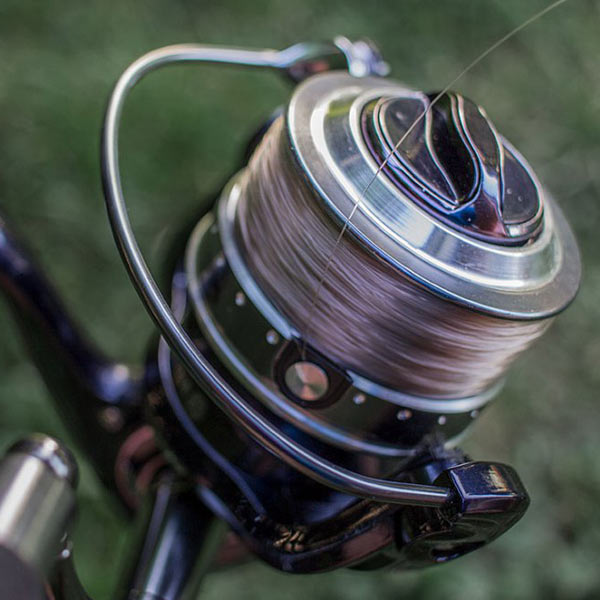
What makes a reel for feeder fishing suitable for this technique? Many characteristics have to be taken into account, particularly the spool, the retrieve speed, the drag, the strength… But to my mind, the essential thing is not there! Your feeder reel must be one with its partner: the feeder rod. The balance must be perfect and the size of the reel matched to the rod.
Fishing distance when choosing a reel for feeder fishing
The size of a feeder reel increases with the fishing distance you want to reach, and therefore also with the length of the rod used. It is therefore important to have a balanced feeder rod and reel to ensure a smooth, accurate cast without tangles. The shorter you fish, the lighter you fish. In that case your rod will not be very powerful, but rather short and light. A medium-sized reel will then be enough (2500 to 3000).
For longer-distance fishing, or on big rivers and rivers with a strong current, using a longer, more powerful rod will be more suitable. To ensure good balance, your reel will then be bigger (4000 or more) and have a wider, deeper spool to hold more line.
For long casting distances, you will choose a Longcast-type reel. This feeder reel has a spool that is wider, taller and deeper, which makes it possible to lengthen your casts.
Characteristics to look for when choosing a reel for feeder fishing
To make the most of your fishing session, your feeder reel must have certain characteristics. To choose your feeder fishing reel, strength, retrieve speed, drag… must all be taken into consideration.
Strength
Avoid all-“plastic” reels, cheap bargain-bin models, unknown brands… In short, go for a reel with the best value for money. Do not hesitate to handle the reel in the shop and test it. A reel that already has play when you handle it, a foot that lacks rigidity, a handle that does not turn smoothly, an approximate anti-reverse, bearings in which you can feel the balls, are all signs that will guide your choice.
The number of bearings.
Generally given as 4 + 1, 5 + 1. This corresponds to the number of “normal” bearings plus the roller bearing (+1), which easily replaces several of them.
You can find high-quality reels with only 6 bearings. But you also find lower-quality reels with 12 bearings. The number of bearings lets the spool turn on its axis as smoothly and gently as possible, ensuring superior fishing comfort.
The quality of the bearings is also decisive in your choice. Ceramic bearings, or bearings with an anti-corrosion treatment, last far better over time than ordinary steel bearings.
Some feeder reel brands use bearings such as AR-B for Shimano or CRBB for Daiwa. These bearings are often reserved for mid-range and high-end reels. They give an almost perfect spool rotation and considerably increase the life of your reel.
Waterproofing and corrosion resistance are also important points. The Magsealed oil that is fitted to more and more Daiwa reels makes the important parts of the reel watertight.
Retrieve speed
What is the retrieve speed (also called the ratio)? It is the length of line put back onto your spool with each turn of the handle. Choose a reel with a high retrieve speed, about 90 cm per turn of the handle. That way, when fishing at long distance you will bring your rig back faster. A high ratio lets you fight energetic fish close to obstacles, which have to be pulled away quickly!
The drag
The drag of your reel lets you lock or release the line if the tension the fish puts on the line is too strong. Among other things, this avoids line breakage by releasing the rotation of the spool during fights with fish. During the fight the spool turns on itself under the effect of the pull, which must be even, without jerks. That is a sign of a good-quality drag. The drag is a powerful ally in your fishing and needs to be reliable and precise.
The power of the drag is expressed in kilograms. It indicates the maximum force the drag applies without releasing the rotation of the spool. A tightened drag with a maximum power of 5 kg blocks the rotation of the spool for an equivalent tension on the line. Beyond this point, the spool will release (if the drag is set correctly). For quiver-tip or method feeder fishing, a 5 kg drag is enough. The fish caught are not as powerful as those caught by lure anglers (unless you are trying for big carp).
For our part, after testing several reels for feeder fishing, we settled on the following model. The Daiwa PROCASTER EVO 3008 feeder reel. Whether at short or long distance, for small fish or for carp, this reel for feeder fishing will satisfy you in almost all fishing conditions.