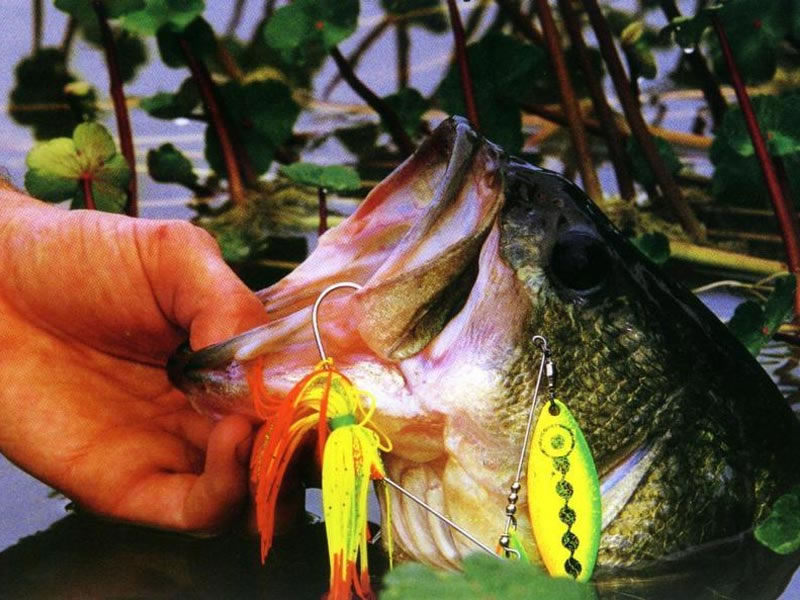
How to fish with a spinnerbait? If you are looking to improve your spinnerbait fishing skills, you have come to the right place! If you want to know how to fish with spinnerbaits, we will give you practical advice, tips and techniques to help you succeed. The spinnerbait is a popular technique for catching every kind of predator. By presenting and working your spinnerbait properly, you can catch them easily.
We are a team of experienced anglers who have spent many years learning the ins and outs of this fascinating fishing technique. Whether you are a beginner or a seasoned angler, we are here to help you improve your skills. We are delighted to share our expertise with you, and we hope you will enjoy reading this article as much as we enjoy writing it for you. In short, if you want to be successful with spinnerbaits, we have everything you need to get there!
What is a spinnerbait?
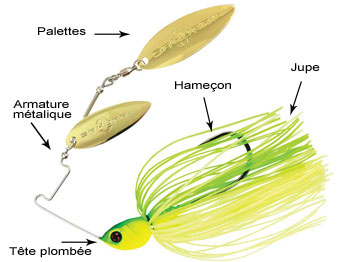
Straight from the United States, the spinnerbait is a lure unlike any other! It belongs to the family of metal lures, just like the spoon or the buzzbait. Originally designed for black bass fishing, this lure is also extremely effective on all kinds of predators (pike, zander, perch, etc.). It is very versatile and can be fished just under the surface as well as close to the bottom.
A spinnerbait has a V-shaped wire frame. The lower arm carries a jig head fitted with a skirt made of ultra-soft silicone strands that give it volume. The jig head usually represents the head of a fish and is shaped to glide over obstacles. The upper arm carries one or more blades. The last one, at the tip, is mounted on a swivel that lets it spin perfectly. The other blades on the arm are mounted on a clevis.
But what really sets the spinnerbait apart is its ability to slip through obstacles thanks to its clever design. The V-shaped frame, combined with the rotating blade, gives exceptional protection against snags. The hook sits behind the frame, which protects it, while the blade acts as a deflector that pushes obstacles aside. This unique design lets you fish a spinnerbait in the most cluttered areas, where predators take cover, without being afraid of losing your lure.
How to choose your spinnerbait
Choosing a spinnerbait depends on several key factors, which we will go through in this article. First of all, the size and weight of the lure must suit the targeted predator and the fishing conditions. Smaller models are perfect for perch and zander, while larger ones are more effective for pike. Then colour is a crucial element: bright colours are ideal for murky water, while natural colours are better in clear water.
The type of blade is also important: Colorado blades produce strong vibrations, which are perfect for coloured water, while Willow blades are more discreet and suited to clear water. Finally, when fishing with a spinnerbait, remember to take the fishing environment into account: if you are fishing cluttered areas, choose a spinnerbait with a solid frame and a protected hook.
Blades: shapes, sizes and colours for the best action
The blades are the key element of the spinnerbait: they determine its action and its appeal. There are different blade shapes, each with a specific effect:
Colorado: Shaped like a wide, round leaf, it produces strong pulsations and starts working immediately. It is ideal for slow, precise fishing, especially in cluttered areas. Its angle of rotation is far from the central axis, so it tends to pull harder during the retrieve. It is best used for slow fishing.
Willow: Longer and slimmer, it has a narrower angle of rotation and pulls less on the line. With intense vibrations, it allows a faster retrieve. It is perfect for searching large areas and for fishing in currents.
Indiana: A compromise between the Colorado and the Willow, it combines pulsations and vibrations. It is versatile and adapts to different fishing conditions.
The size and colour of the blades also matter. Larger blades create more vibration and flash, while smaller blades are more discreet. Bright colours are effective in clear water, while natural colours are better in murky water.
Choosing the right spinnerbait colour for every situation
Choosing the colour is crucial for getting the best results when fishing with a spinnerbait. Take into account:
Water clarity
Clear water: Natural, discreet colours are best, such as white, silver, gold or transparent. These colours imitate the predators' natural prey and are less likely to scare them.
Murky water: : Bright, flashy colours are more effective, such as chartreuse, red, orange or pink. These colours are more visible in dark water and attract the attention of predators.
Light
Sunny day: Light, reflective colours are ideal, such as silver, pearl or white. These colours reflect the sunlight and create flashes that attract fish.
Cloudy day or dusk: Dark, contrasting colours are more effective, such as black, brown or dark green. These colours stand out better in dark water and are easier for predators to spot.
Type of prey: Try to match the colour of your spinnerbait to the prey the predators are hunting in your fishing area. If the baitfish are mainly roach, use a silver spinnerbait. If crayfish are plentiful, choose a brown or orange spinnerbait.
The best techniques for fishing with a spinnerbait
The spinnerbait offers a huge range of possibilities in terms of presentation, even in the most difficult areas. Here are some of the most effective techniques:
- Straight retrieve: This is the basic technique, which consists of bringing the lure back at a steady speed. It is effective for quickly searching shallow areas and mid-water, taking advantage of the spinnerbait's ability to pass through obstacles.
- Buzzing: This technique consists of retrieving the lure quickly at the surface so that the blade slaps the water. It imitates fleeing prey and often triggers spectacular strikes, even in cluttered areas.
- Free falling: This technique consists of letting the spinnerbait sink along obstacles while controlling its descent. It is particularly effective for pike lying near the bottom, taking advantage of the lure's ability to slip through branches and weed beds.
- Slow rolling: This technique consists of retrieving the lure slowly near the bottom, concentrating on the areas where fish are likely to be. It is ideal for slow, meticulous fishing, exploring every corner of cluttered areas.
Our advice for choosing and using a spinnerbait
The first thing to do is to match your spinnerbait carefully to the species you want to catch. Not all predators react in the same way, so here is some advice to help you choose your lure.
Pike : Pike have a weakness for large lures. A model with Colorado blades will do the job, especially in weed beds where they like to hide.
Black bass : for this predator, it is better to choose medium-sized spinnerbaits. Models with Colorado-type blades, which produce strong vibrations, are perfect for attracting this fish.
Zander : although the spinnerbait is not necessarily the first choice for zander, it can sometimes make the difference. Choose models fitted with willow-leaf blades to fish deeper, and make them work close to the bottom.
In addition, to choose the spinnerbait that suits your needs, consider the following factors:
Size and weight: Match them to the targeted predator and to the fishing conditions.
Colour: Take into account water clarity, light and the type of prey.
Environment: The spinnerbait is ideal for shallow areas, weed beds, cluttered banks, calm rivers and still waters.
Season: It is effective from early spring to late autumn, especially in spring in weed beds.
Recommended tackle for spinnerbait fishing
To get the most out of the spinnerbait, it is essential to have the right tackle:
The reel
It is the “winch” effect that is useful here. Since the line is in line with the spool, retrieving a lure that pulls hard becomes easier and more comfortable. To emphasise the winch effect and be able to fish slowly with a straight retrieve, a low-ratio baitcasting reel is preferred, such as a 6.3:1 for a retrieve of 67 cm per turn (Daiwa TATE19100HL). Choose a reel with a capacity suited to the type of fishing you do and to the size of the fish you are targeting.
The rod
A medium-heavy rod of about 2.10 m is versatile. It covers most situations, and its power (10-40 g) lets you cast spinnerbaits of various sizes. However, in wide open spaces, a longer rod (up to 2.40 m) gives better casts to gain distance, from the bank or from a boat. Prefer rods made partly of fibreglass (5%). Fibreglass adds flexibility and absorbs the vibrations of the lure. Besides, spinnerbaits provoke violent strikes. The rod must therefore absorb these strikes and so limit hook-pulls, which is crucial at the start of the fight.
The line
For the main line, braid is preferable. Its diameter and strength must be chosen according to the fish you are after, the spinnerbait you have picked and the fishing situation. Its lack of stretch means that you must use a rod that is not too stiff.
For the leader, choose fluorocarbon of 0.80 to 0.90 mm for pike. The size of the fluorocarbon does not hinder the swimming of the spinnerbait. For other predators, choose a smaller diameter suited to the size of the spinnerbait. You can also add a fluorocarbon shock leader between the braid and the leader. A few metres long, this shock leader keeps the braid away from your spinnerbait and so makes the rig more discreet.
It is better to tie the spinnerbait directly to the leader. Avoid snaps: a snap can slide along the frame, unless the lure has a rubber ring to hold the snap in place.
The spinnerbait is much more than just another predator lure! It is a versatile, effective tool, above all designed for fishing without snags in the most cluttered areas. By mastering the different working techniques, choosing the right blades and colours, and using the recommended tackle, you will get the best out of spinnerbait fishing and make memorable catches, even in the most complex environments.